 Skip to main content



For most navigators, the sound of an ECDIS alert is unmistakable. Depending on the watch, an ECDIS alert can mean anything from a routine chart update to an imminent grounding risk. The challenge is knowing which is which – and acting accordingly.
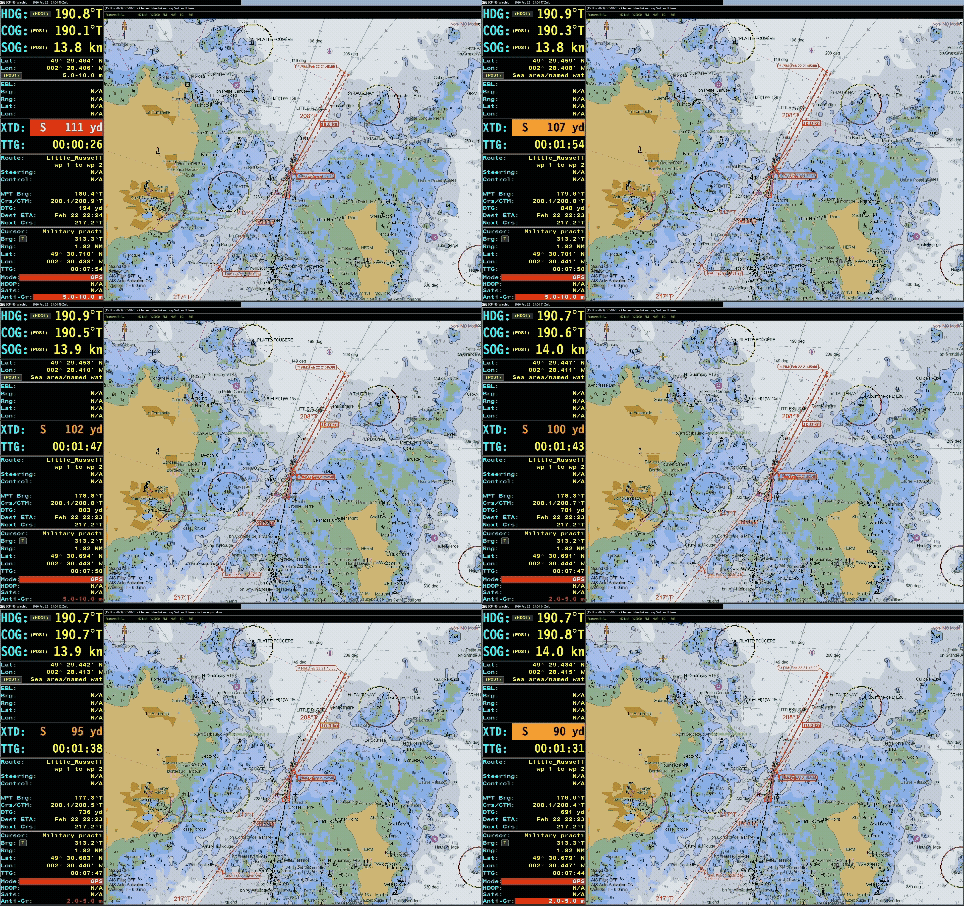
While alerts are intended to signal navigational risk, when approaching port or in a traffic separation scheme, these alerts can often arrive in quick succession: a buoy update, a caution area, a chart note. Each one competes for the bridge team's attention at exactly the moment when that attention is most stretched.
This is a widely recognised challenge. In fact, in NorthStandard’s latest ECDIS Training Assessment report found that 50% of crew members struggled to distinguish between high-priority alarms and general alerts, and half of bridge team members could not identify the specific conditions that would trigger an alarm on their own system.
For bridge teams managing a busy watch, this gap matters. An alert system that is not fully understood cannot fully protect the vessel it is designed to serve.
This short guide is designed to help mariners understand how ECDIS alerts are structured and what they are designed to signal, based on information from the ADMIRALTY Guide to the Practical Use of ENCs (NP231).
Why fewer alarms can mean safer navigation
When ECDIS became standard across the global fleet, a practical problem emerged: too many audible alarms.
The issue was not that the system was wrong to sound them, but that the sheer frequency of alerts was eroding bridge teams’ responsiveness. When every alert sounds urgent, none of them feel urgent. ‘Alarm fatigue’ is well-documented across safety-critical industries, and in a bridge environment, its consequences are particularly serious.
To address this, the International Hydrographic Organization (IHO) revised the S-52 Presentation Library to version 4.0. One of its core aims was to harmonise ECDIS behaviour across manufacturers and reduce unnecessary audible alarms.
The revised model narrows the conditions that trigger a sound alert. In practical terms: when a modern ECDIS sounds an audible alarm, it is signalling something that genuinely requires attention, whereas visual indications are used for cautions that are less critical. Understanding that distinction is the foundation of confident watchkeeping.
Understanding the alert hierachy
Under Bridge Alert Management (BAM) standards, alerts are used to signify abnormal situations and conditions requiring attention, but not all alerts carry the same priority. Understanding the ECDIS alert hierarchy is critical for PSC inspections and navigational audits.
|
Alert type |
What it means |
Visual indication and sound |
|---|---|---|
|
Alert type Emergency alarm |
What it means Highest priority; typically associated with shipboard emergency systems such as fire detection or distress signals. Requires immediate response.
Note: In modern 2026 systems, these alerts often bypass the ECDIS screen to avoid cluttering the navigator's critical view of the chart during a crisis. |
Visual indication and sound Flashing red, with a continuous sound. |
|
Alert type Alarm |
What it means Requires immediate attention and action to maintain safe navigation. |
Visual indication and sound Flashing red, sounding every 7-10 seconds. |
|
Alert type Warning |
What it means Requires immediate attention, though corrective action may not be immediately necessary. |
Visual indication and sound Flashing orange, sound every 15 seconds to 5 minutes. |
|
Alert type Caution |
What it means Indicates a condition the bridge team must be aware of, but which does not yet demand action. |
Visual indication and sound Yellow indicator, with no audible sound. |
Recognising these distinctions can help navigators prioritise attention during a busy watch. It also ensures audible alarms retain their intended significance.
A definitive breakdown can be found on page ix of the ADMIRALTY Guide to the Practical Use of ENCs (NP231).
Difference between red alarms and yellow indications
ECDIS alerts rely on a combination of visual indications and audible alarms. Understanding the distinction helps bridge teams interpret what the system is signalling.
Red alerts– audible alarms
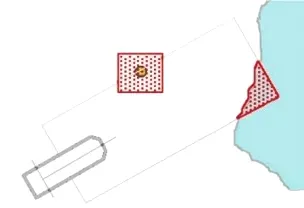
During route monitoring, the safety contour is the primary automatic audible alarm required by IMO performance standards.
If the vessel’s look-ahead vector crosses the safety contour, the ECDIS will generate a red bounding box highlighting the hazard and a persistent audible alarm. This indicates that the vessel may enter water shallower than the defined safety parameters – a situation requiring immediate attention.
These require an immediate response and follow a standardized BAM sound pattern of 3 short signals every 7–10 seconds.
Yellow indications – visual alerts
Many other hazards, including rocks, wrecks and obstructions, fall within the ‘Detection and Notification of Navigational Hazards’ category.
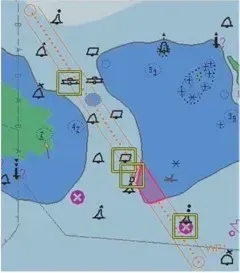
When encountered during route planning, these features may appear with a yellow bounding box within a user-defined distance of the track.
In many cases they generate a visual indication without triggering an audible alarm. This reduces unnecessary sound alerts while still highlighting hazards that require review during route planning.
This is the S-52 model working as intended: audible alarms reserved for situations requiring immediate action, visual indications for hazards that require review. The result is a quieter bridge where the alarms that do sound carry real weight.
For a complete list of which S-57 features generate these yellow highlights versus red alarms, bridge teams can consult pages 54-55 of NP231.
Five mandatory alarms
While many navigators focus solely on depth, IMO performance standards mandate five specific alarms – and understanding the logic behind these triggers is essential for maintaining a secure watch.
|
Mandatory ECDIS alarm |
What triggers it |
Why it matters for navigation |
|---|---|---|
|
Mandatory ECDIS alarm Crossing the safety contour |
What triggers it The vessel moves from water deeper than the configured safety contour into water that is equal to or shallower than the safety contour. |
Why it matters for navigation Primary anti-grounding alarm. Warns the bridge team that the vessel is approaching water shallower than the defined safety margin. |
|
Mandatory ECDIS alarm Deviation from route |
What triggers it The vessel moves outside the permitted cross track distance from the planned route. |
Why it matters for navigation Alerts the navigator that the ship is leaving the planned safe track and may be approaching hazards. |
|
Mandatory ECDIS alarm Positioning system failure |
What triggers it The primary position input (e.g. GPS/GNSS) is lost, unreliable, or disconnected. |
Why it matters for navigation Without a valid position input, ECDIS cannot reliably show the vessel’s location on the chart. |
|
Mandatory ECDIS alarm Approach to a critical point |
What triggers it The vessel is approaching a defined navigational event, such as a waypoint or course alteration. |
Why it matters for navigation Prompts the bridge team to prepare for an upcoming manoeuvre or navigational decision. |
|
Mandatory ECDIS alarm Different geodetic datum |
What triggers it The chart datum used by the ENC differs from the datum used by the positioning system. |
Why it matters for navigation A datum mismatch can shift the displayed vessel position by hundreds of metres, potentially showing the vessel in safe water when it is actually near a hazard. |
The geodetic datum alarm is worth particular attention. While it does not relate to an immediate physical hazard, a datum mismatch can place the vessel hundreds of metres from its actual position on the chart.
The role of S-101
The next generation S-101 Electronic Navigational Chart (ENC) standard will continue to refine how ECDIS manages navigational information.
S-101 introduces more structured and granular data. Over time, this will enable ECDIS to provide more targeted alerts – better distinguishing between hazards that present a real risk to a vessel’s draught and those that are simply nearby.
For navigators, this should mean clearer signals and fewer distractions; a continuation of the same direction set by the S-52 revision.
Supporting confident ECDIS use
ECDIS alerts are not all the same; and they are not designed to be. The hierarchy from caution to emergency alarm exists precisely so that bridge teams can prioritise their attention.
For mariners seeking to deepen their understanding, the ADMIRALTY Guide to the Practical Use of ENCs (NP231) offers a practical reference for using ENCs effectively in day-to-day operations.
This publication provides detailed guidance on:
- how ECDIS alerts are structured
- how ENC features generate alerts or indications
- route planning and route monitoring
Contact you ADMIRALTY distributor to find out more >
Read more about our range of ADMIRALTY Reference Publications >
Read more on this topic

Search Title
Reducing friction in passage planning
Efficient passage planning depends on bringing together trusted information from multiple sources. As the volume of information available to bridge teams grows, the challenge is increasingly about finding what matters and understanding it efficiently. We explore how reducing unnecessary friction can give navigators more time to focus on the decisions that support safe navigation.
Search Title
Understanding ECDIS: Beyond the default 30m safety contour
Setting the ECDIS safety contour correctly is one of the most effective things a bridge team can do to prevent grounding. When configured for the vessel's actual draught, margins and operating conditions, it controls how depth information is displayed in ECDIS and alerts the crew before the vessel approaches unsafe water.
Search Title
Why ECDIS training remains critical for safe navigation
New data from NorthStandard highlights where bridge teams are confident with ECDIS and where understanding can be strengthened.